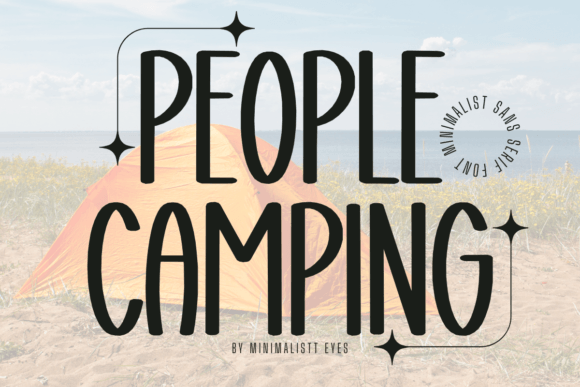
People Camping: A Typeface That Feels Like a Weekend Getaway
There's a particular kind of magic that happens when typography perfectly captures a mood. You know the feeling—you're scrolling through a website or flipping through a booklet, and something about the lettering just makes you pause. It's not loud or aggressive. It doesn't demand your attention with sharp angles or dramatic contrasts. Instead, it wraps around the words like a cozy blanket on a cool evening. That's the experience of working with People Camping, a sans-serif typeface that has quietly been winning over designers, entrepreneurs, and creative professionals who crave warmth in their visual communication.
At first glance, People Camping might remind you of hand-lettered signs at a summer festival or the friendly chalkboard menu at your favorite neighborhood café. Its curves are soft, its edges rounded, and its personality is unmistakably approachable. But don't mistake that friendliness for a lack of sophistication. This is a carefully crafted display font that understands exactly what it wants to be—and delivers on that promise with remarkable consistency across a wide range of applications.
Why Warm Typography Matters More Than You Think
We live in an era where consumers are bombarded with thousands of visual messages every single day. Sleek, minimalist design has its place, but there's a growing hunger for brands and projects that feel human, authentic, and inviting. People Camping speaks directly to that desire. Its visual DNA is rooted in modern sans-serif principles, which means it maintains excellent legibility, but its playful curves and rounded terminals inject a sweetness that sterile geometric fonts simply cannot replicate.
Consider the difference between walking into a stark, all-white gallery space versus a sunlit room filled with plants and handmade pottery. Both can be beautiful, but one immediately puts you at ease. That's the kind of emotional response People Camping is engineered to evoke. For small business owners trying to build trust with their audience, or content creators looking to establish a recognizable visual voice, this kind of typographic warmth isn't just a nice-to-have—it's a strategic advantage.
Where This Font Truly Shines
The versatility of People Camping is one of its greatest strengths, though it's worth understanding where it performs at its absolute best. As a display font, it's naturally suited to headline work, logos, and any context where the type needs to carry personality at larger sizes. Think about the branding for a children's bookstore, the packaging for an artisanal granola company, or the invitation suite for a rustic outdoor wedding. In each of these scenarios, the font does more than convey information—it sets a tone.
Here's a practical breakdown of projects where People Camping can make a real difference:
- Logo design and brand identity systems for lifestyle brands, family-oriented businesses, and creative studios
- Packaging design for food products, handmade goods, cosmetics, and specialty retail items
- Social media graphics where you need to stop the scroll with a friendly, approachable aesthetic
- Website headers and hero sections that welcome visitors before they read a single word of copy
- Blog post titles and editorial layouts for publications targeting creative or lifestyle audiences
- Print materials including flyers, postcards, brochures, and event programs
- Poster design for community events, farmers' markets, workshops, and seasonal promotions
- Merchandise such as tote bags, mugs, t-shirts, and stickers
- Digital products like e-books, worksheets, planners, and online course materials
- Invitations and stationery for both personal celebrations and corporate events with a relaxed vibe
Marketing professionals will find it particularly useful for campaigns that target families, young adults, or anyone who responds to messaging that feels genuine rather than corporate. The font essentially does some of the emotional heavy lifting for you, establishing warmth before the viewer even processes the actual words.
Pairing People Camping with Other Typefaces
No font exists in isolation, and understanding how to pair People Camping with complementary typefaces will dramatically expand its usefulness. Because it occupies the display category with its bold, rounded character, it pairs beautifully with cleaner, more neutral sans-serif fonts for body text. A simple, highly readable typeface for paragraphs and longer passages creates a natural hierarchy that guides the reader's eye without creating visual conflict.
For projects that want to lean into a more editorial or traditional feel, consider pairing it with a classic serif font. The contrast between People Camping's playful sans-serif personality and the structured elegance of a serif typeface can create layouts that feel both modern and timeless—think lifestyle magazine spreads or boutique brand lookbooks.
A few pairing strategies worth testing:
- Use People Camping for all headlines and subheadings, with a neutral sans-serif like a geometric or humanist typeface for body copy. This keeps the overall feeling cohesive and contemporary.
- Combine it with a subtle script font for accent text on invitations or packaging. The handwritten quality of the script complements People Camping's rounded warmth without competing for attention.
- Pair it with a bold, condensed serif for editorial layouts where you want to create dramatic contrast between headline and body. This works especially well in poster design and magazine features.
The key is to test your pairings in context. Don't just set two fonts side by side in a design tool and call it done. Place them in your actual project—on the real packaging mockup, in the actual website layout, on the printed invitation proof—and evaluate how they interact at the sizes and weights you'll actually use.
Readability and Practical Considerations
One question that comes up with any display-oriented typeface is readability, and it's an important one. People Camping performs admirably at medium to large sizes, which is exactly where a display font should live. Its rounded letterforms and generous spacing make it easy to read in headlines, subheadings, pull quotes, and short blocks of text. However, like most display fonts, it's not designed for extended body copy at small sizes. That's not a limitation—it's simply a matter of using the right tool for the right job.
When working on web design projects, pay attention to how the font renders across different screen sizes and devices. Test it on mobile phones, tablets, and desktop monitors. What looks charming and readable on a 27-inch screen might feel slightly cramped on a phone if the font size isn't adjusted appropriately. Most modern design workflows make this kind of responsive testing straightforward, so take advantage of it.
For print applications, always request or produce a physical proof before committing to a large run. Typography that looks perfect on screen can sometimes surprise you in print, particularly with specialty papers or unusual printing techniques like letterpress or foil stamping. People Camping's rounded, friendly forms generally reproduce well across printing methods, but it's always worth verifying.
Building a Consistent Brand Voice with Typography
One of the most overlooked aspects of brand building is typographic consistency. Many small business owners and entrepreneurs invest significant time and money in logo design and color palettes, then use whatever default fonts come with their design software for everything else. This creates a subtle but real disconnect in how the brand is perceived. When your logo says one thing and your social media graphics say another, the overall message feels fragmented.
Choosing a typeface like People Camping as part of your core brand identity toolkit—and then using it consistently across touchpoints—creates a visual thread that ties everything together. Your Instagram posts feel connected to your website headers, which feel connected to your printed materials, which feel connected to your email newsletters. That consistency builds recognition, and recognition builds trust.
Before committing to any premium font for your brand, create a small test project. Design a business card, a social media post, a simple landing page mockup, and a printed flyer. Live with those designs for a few days. Share them with trusted colleagues or customers and ask for honest feedback. Does the typography support the message you're trying to communicate? Does it resonate with your target audience? Does it feel authentic to who you are as a business or creator?
Licensing and the Business of Fonts
A practical note that too many creative professionals learn the hard way: always verify the commercial licensing terms of any font you plan to use for client work, merchandise, or business purposes. People Camping, like many premium design assets, comes with specific licensing agreements that outline how the font can be used. Desktop licenses typically cover creating static designs like logos and print materials, while web font licenses are needed for embedding the typeface on websites. If you're creating products for sale—think t-shirts, mugs, or digital downloads—make sure your license covers that use case.
Investing in properly licensed fonts isn't just about legal compliance. It's about supporting the designers and foundries who create these tools that make our work better. When you purchase a commercial font, you're investing in quality craftsmanship, ongoing updates, and the continued development of creative resources that benefit the entire design community.
People Camping represents exactly the kind of thoughtfully designed typeface that earns its place in a serious designer's toolkit. It doesn't try to be everything to everyone. Instead, it does what it does with confidence and charm—bringing a genuine sense of warmth and approachability to every project lucky enough to feature it. Whether you're building a brand from scratch, refreshing an existing visual identity, or simply looking for a font that makes your next project feel a little more human, this is a typeface worth exploring.